
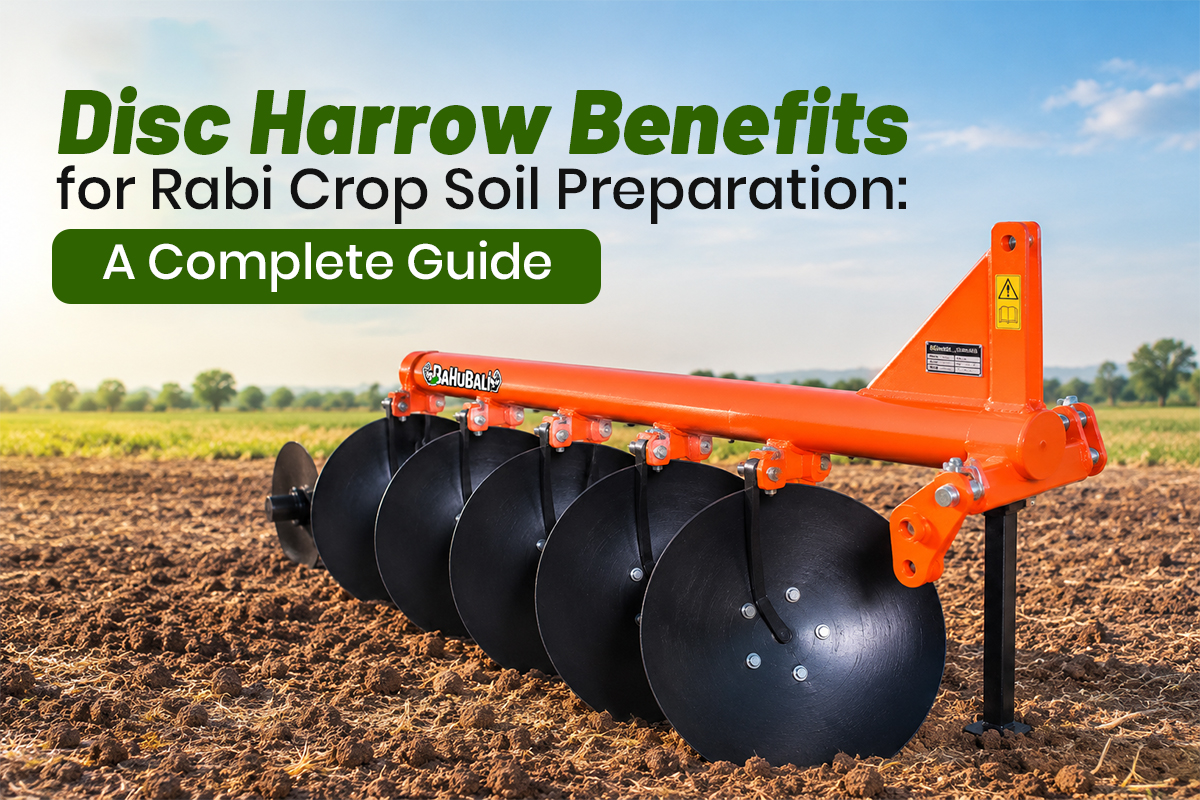
As the Kharif harvest winds down, the focus of the Indian farmer shifts rapidly to the Rabi season. Preparing the soil for winter crops like Wheat, Mustard, and Chickpeas is a race against time and moisture. In this critical window, one implement stands out as a versatile workhorse: the Disc Harrow. While many farmers think of it only for primary tillage, the disc harrow is actually one of the most effective tools for secondary Rabi preparation.
At Bhansali Agrotech, with 25+ years of experience in agricultural engineering and exports to 48+ countries, we have seen how a well-timed pass with a disc harrow can transform a field. In this guide, we explore the specific benefits of using a disc harrow for your Rabi crops.
What is a Disc Harrow?
A disc harrow consists of two or more gangs of high-carbon steel discs, set at an angle. As the tractor pulls the harrow, the discs rotate, cutting into the soil, breaking clods, and mixing the top layers. It is a bridge between heavy ploughing and fine finishing.
Detailed Explanation: Why the Disc Harrow is a Rabi Essential
1. Superior Residue Management
Rabi crops often follow Paddy or Soyabean, which leave behind tough, fibrous stubble.
* The Benefit: A disc harrow cuts through this residue instead of just dragging it (as a cultivator might). By chopping the stalks and mixing them with the top 4-6 inches of soil, it speeds up decomposition and prevents the stubble from clogging your seed drill.
2. Breaking the “Monsoon Crust”
The heavy rains of the monsoon often leave the soil surface compacted and “crusty.”
* The Benefit: The sharp discs of a Bhansali Agrotech harrow slice through this crust, aerating the soil and allowing the cooler winter air to reach the root zone. This “breathing” soil is essential for the healthy germination of Rabi seeds.
3. Moisture Conservation (The “Dust Mulch” Effect)
In Rabi farming, soil moisture is your most precious resource.
* The Benefit: A disc harrow creates a layer of loose, fine soil on the surface. This acts as a “dust mulch,” which breaks the capillary action of the soil and prevents moisture from evaporating into the dry winter air. This can save you an entire irrigation cycle later in the season.
4. Leveling and Seedbed Refinement
For crops like Wheat and Mustard, you need a level field for uniform irrigation.
* The Benefit: Modern harrows, like the BAHUBALI range, are designed to level the soil as they work. They break down large clods into smaller pieces, creating a tilth that is perfect for precision seed drills.
Benefits for Farmers: ROI and Yield
- Fuel Efficiency: A disc harrow covers a large area in a single pass. Compared to multiple passes with a cultivator, it can save you 15-20% on diesel.
- Higher Germination: By creating a uniform, moist seedbed, the disc harrow ensures that your seeds sprout faster and more consistently.
- Reduced Weed Pressure: The cutting action of the discs destroys the root systems of monsoon weeds that are trying to survive into the winter, giving your Rabi crop a “clean start.”
- Versatility: You can use the same harrow for primary tillage in soft soil and secondary tillage in hard soil, making it a highly cost-effective investment.
How to Choose the Right Disc Harrow
- Mounted vs. Trailed: Mounted harrows (attached to the 3-point linkage) are great for smaller fields and maneuverability. Trailed harrows (pulled by a drawbar) are better for large, open fields and deeper penetration.
- Number of Discs: Match the number of discs to your tractor HP.
35-45 HP: 12 to 14 Discs
50-60 HP: 16 to 20 Discs - 35-45 HP: 12 to 14 Discs
- 50-60 HP: 16 to 20 Discs
- Disc Type: For Rabi prep, “notched” or “scalloped” discs on the front gang are better for cutting residue, while plain discs on the rear gang provide a smoother finish.
- 35-45 HP: 12 to 14 Discs
- 50-60 HP: 16 to 20 Discs
Why Bhansali Agrotech?
Bhansali Agrotech’s disc harrows are the gold standard for durability.
* High-Carbon Steel Discs: Our discs are made to international standards, ensuring they stay sharp and resist chipping even in stony ground.
* Heavy-Duty Frame: The BAHUBALI frame is built to provide the weight necessary for deep penetration without needing extra weights.
* Precision Bearings: We use high-quality, dust-sealed bearings that ensure smooth rotation and long life with minimal maintenance.
* Global Reputation: We export our harrows to 48+ countries, where they are trusted by professional farmers for their performance and reliability.
Frequently Asked Questions (FAQs)
1. Can a disc harrow replace a rotavator?
In some soils, yes. A disc harrow is better for cutting residue and conserving moisture, while a rotavator provides a finer finish. Many farmers use a disc harrow first to manage residue and then a rotavator for the final seedbed.
2. Does a disc harrow cause soil compaction?
If used at the same depth year after year, it can create a “plough pan.” It is always a good idea to use a sub soiler or deep plough once every 2-3 years to break this up.
3. What is the “gang angle” and why does it matter?
The gang angle is the angle of the discs relative to the direction of travel. A sharper angle provides deeper penetration and more aggressive soil turning, which is ideal for breaking hard Rabi soil.
4. How do I maintain my disc harrow?
The most important maintenance is greasing the bearings and checking the tightness of the disc nuts. After the season, coat the discs with oil to prevent rust.
5. Is it safe to use a disc harrow in stony ground?
Yes, Bhansali Agrotech harrows are built with flexible frames and high-quality steel discs that can handle small to medium stones. However, for very large rocks, a disc plough is a safer choice.
Conclusion
The disc harrow is the “unsung hero” of the Rabi season. By cutting residue, conserving moisture, and preparing a perfect seedbed, it sets the stage for a high-yield winter harvest. If you want a tool that is fast, efficient, and built to last, a Bhansali Agrotech disc harrow is the perfect addition to your farm.
Prepare for Rabi success today!
Contact Bhansali Agrotech to find the right disc harrow for your tractor and soil type. Let’s make this winter your most productive season yet.