Wheat is the backbone of India’s food security and the primary Rabi crop for millions of farmers across the Indo-Gangetic plains and Central India. While wheat is a resilient crop, its yield is highly sensitive to the quality of land preparation and the precision of sowing. In an era where climate change is making winters shorter and hotter, the ability to prepare the land and sow quickly is the difference between a bumper crop and a failed one.
Bhansali Agrotech, with 25+ years of expertise and a global presence in 48+ countries, provides a complete “Wheat Success Suite.” In this guide, we walk through the essential implements required at every stage of wheat cultivation.
The Stages of Wheat Mechanisation
Wheat cultivation can be broken down into three main mechanical phases: Residue Management, Primary/Secondary Tillage, and Precision Sowing.
Phase 1: Managing the Previous Crop (The Residue Challenge)
In most parts of India, wheat follows paddy or soyabean. Managing the heavy straw left behind is the first big challenge.
* The Tool: Super Seeder or Paddy Rotavator.
* The Role: The Super Seeder is the modern champion of wheat farming. It allows you to sow wheat directly into standing paddy stubble. If you prefer a traditional approach, a Bhansali Agrotech Paddy Rotavator can be used to chop and incorporate the residue into the soil, enriching it with organic matter.
* The Benefit: Eliminates stubble burning, saves 3-4 days of time, and reduces fuel consumption by up to 50%.
Phase 2: Land Preparation (Creating the Perfect Seedbed)
Wheat requires a “fine tilth”—a soil structure that is loose, aerated, and free of large clods.
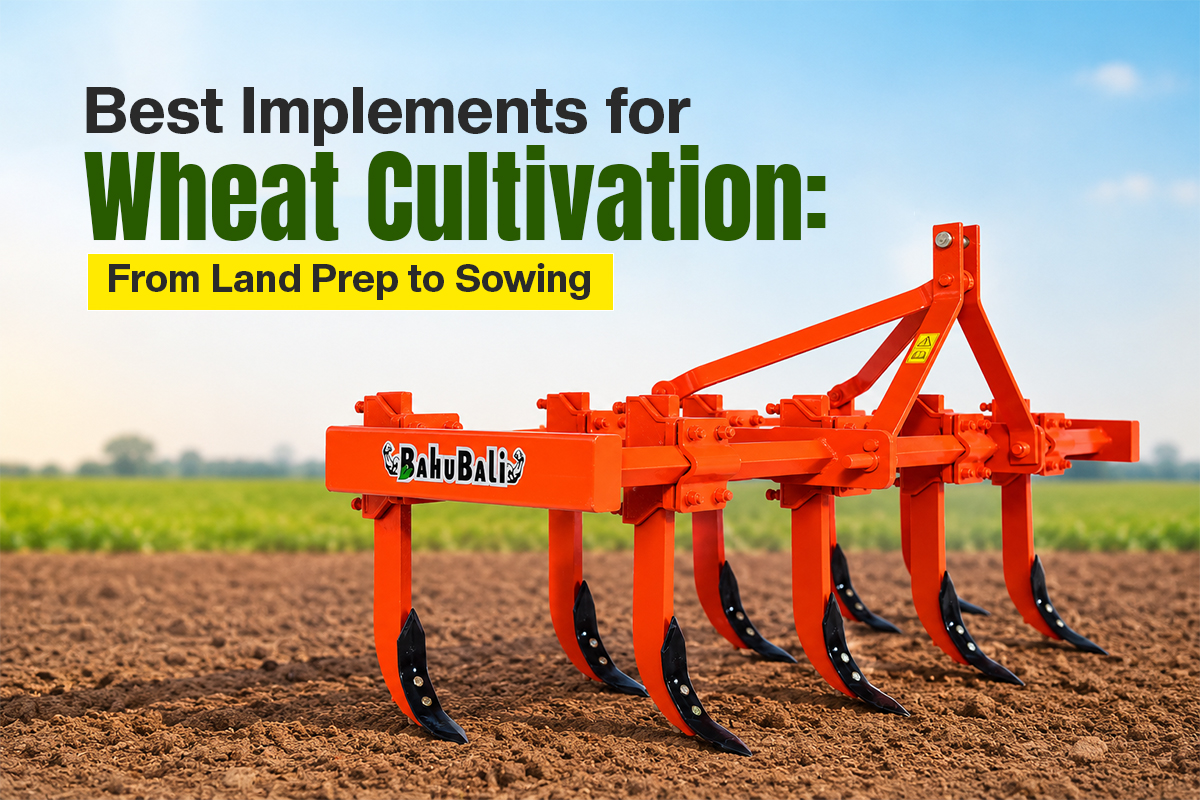
* The Tool: Cultivator and Rotavator.
* The Role: A pass with a spring-loaded cultivator breaks the soil and pulls out any deep-rooted weeds. This is followed by a Rotavator, which pulverizes the soil into a fine powder and levels the field.
* The Benefit: A fine seedbed ensures that the wheat seeds have maximum contact with the soil, leading to fast and uniform germination.
Phase 3: Precision Sowing (The Critical Step)
Wheat yield is determined by the “number of tillers” (shoots) per square metre. This depends entirely on how accurately the seeds are sown.
* The Tool: Seed-cum-Fertilizer Drill.
* The Role: The drill places the wheat seeds at a consistent depth (usually 4-5 cm) and maintains a uniform row-to-row distance (usually 20-22 cm). Simultaneously, it places a dose of fertilizer (DAP/NPK) just below the seed.
* The Benefit: Uniform sowing prevents plants from competing with each other and ensures they all mature at the same time, making the final harvest much easier.
Benefits for Farmers: Why Mechanise Your Wheat Farm?
- Beating the Heat: Late-sown wheat often faces “terminal heat” in March, which shrivels the grain. Mechanisation allows you to sow on time (before Nov 15th), protecting your yield.
- Input Efficiency: A seed drill can save up to 20% on seeds and ensure that every gram of fertilizer is utilized by the plant, not the weeds.
- Soil Health: By using rotavators to incorporate residue instead of burning it, you improve the soil’s water-holding capacity, which is vital for the wheat crop’s 4-5 irrigation cycles.
- Labour Independence: A single tractor and a seed drill can do the work of 20 labourers, ensuring you aren’t dependent on a shrinking workforce during the busy October-November period.
How to Choose the Right Wheat Equipment
- Tractor Matching: For a 9-row seed drill, a 35-40 HP tractor is sufficient. For a Super Seeder, you will need a 50+ HP tractor.
- Soil Type: In the heavy soils of MP, you might need a Disc Plough for primary tillage. In the lighter soils of Punjab/Haryana, a Rotavator is often enough.
- Calibration: Ensure your seed drill is calibrated for the specific variety of wheat you are sowing. Different varieties have different grain sizes and require different seed rates.
Why Bhansali Agrotech?
For over a quarter of a century, Bhansali Agrotech (brand: BAHUBALI) has been the “Iron Partner” of India’s wheat farmers.
* Precision Engineering: Our seed drills are known for their accuracy, ensuring zero seed damage and consistent flow.
* Robust Build: We use high-carbon steel for all wearing parts, ensuring our machines can handle thousands of acres without needing major repairs.
* Global Standard: Our wheat implements are exported to 48+ countries, meeting international standards for performance and safety.
* 25+ Years of Trust: We understand the specific needs of the Indian wheat belt better than anyone else.
Frequently Asked Questions (FAQs)
1. Is “Zero-Tillage” better for wheat?
Yes, in many cases. Zero-tillage (sowing without ploughing) saves time and moisture. However, it requires a specialized Zero-Till Drill or Super Seeder.
2. What is the ideal depth for sowing wheat?
The ideal depth is 4 to 5 centimetres. If sown deeper, the plant uses too much energy to reach the surface. If sown shallower, the roots may not be strong enough.
3. Can I use the same seed drill for Wheat and Mustard?
Yes, Bhansali Agrotech seed drills come with adjustable rollers that can handle both the larger wheat grains and the tiny mustard seeds.
4. How does a rotavator help in wheat farming?
A rotavator is excellent for post-paddy preparation. it chops the leftover straw and creates a very fine tilth in a single pass, which is perfect for wheat.
5. How do I maintain my seed drill after the season?
Empty all boxes, wash off any fertilizer residue (which is corrosive), grease the moving parts, and store it in a dry place. This will ensure it lasts for 15+ years.
Conclusion
Wheat is more than just a crop; it is the lifeblood of the Indian farm. To get the best out of your wheat fields, you need the best tools in your shed. From the first pass of the rotavator to the final row of the seed drill, Bhansali Agrotech is committed to your success.
Get ready for a bumper wheat harvest!
Contact Bhansali Agrotech today to find the perfect implements for your wheat farm. Let’s make this Rabi season your most profitable one yet.