
In the rhythm of Indian agriculture, the transition from the Kharif (monsoon) harvest to Rabi (winter) sowing is one of the most intense periods of the year. Often, farmers have a window of just 15 to 20 days to clear the remains of the previous crop and prepare a perfect seedbed for wheat, mustard, or gram. This “short window” is where your planning and your machinery are put to the ultimate test.
At Bhansali Agrotech, with 25+ years of experience in helping farmers navigate these seasonal shifts, we know that Rabi success is won or lost in the first two weeks of October. In this guide, we provide a step-by-step roadmap for Rabi season readiness.
The Challenge: The “Race Against Time”
The Kharif harvest often leaves the soil in a difficult state. If the monsoon was heavy, the soil might be compacted and full of tough stubble (like Paddy or Soyabean stalks). If the rains ended early, the soil might be bone-dry and hard. Your goal is to manage this residue and create a fine, moist tilth for the Rabi seeds—all while the clock is ticking.
Detailed Explanation: The Post-Kharif Tillage Strategy
Step 1: Managing the Kharif Residue
Burning stubble is not an option for the modern, responsible farmer. It destroys soil health and pollutes the air.
* The Tool: Rotavator or Disc Harrow.
* The Action: A Bhansali Agrotech Rotavator is the fastest way to chop paddy or soyabean stubble and mix it into the soil. This turns “waste” into organic manure for your Rabi crop. If the residue is very thick, a Disc Harrow can be used first to cut through the stalks.
Step 2: Breaking the Compaction
The weight of the monsoon rains and the movement of harvest machinery often compact the soil.
* The Tool: Cultivator or MB Plough.
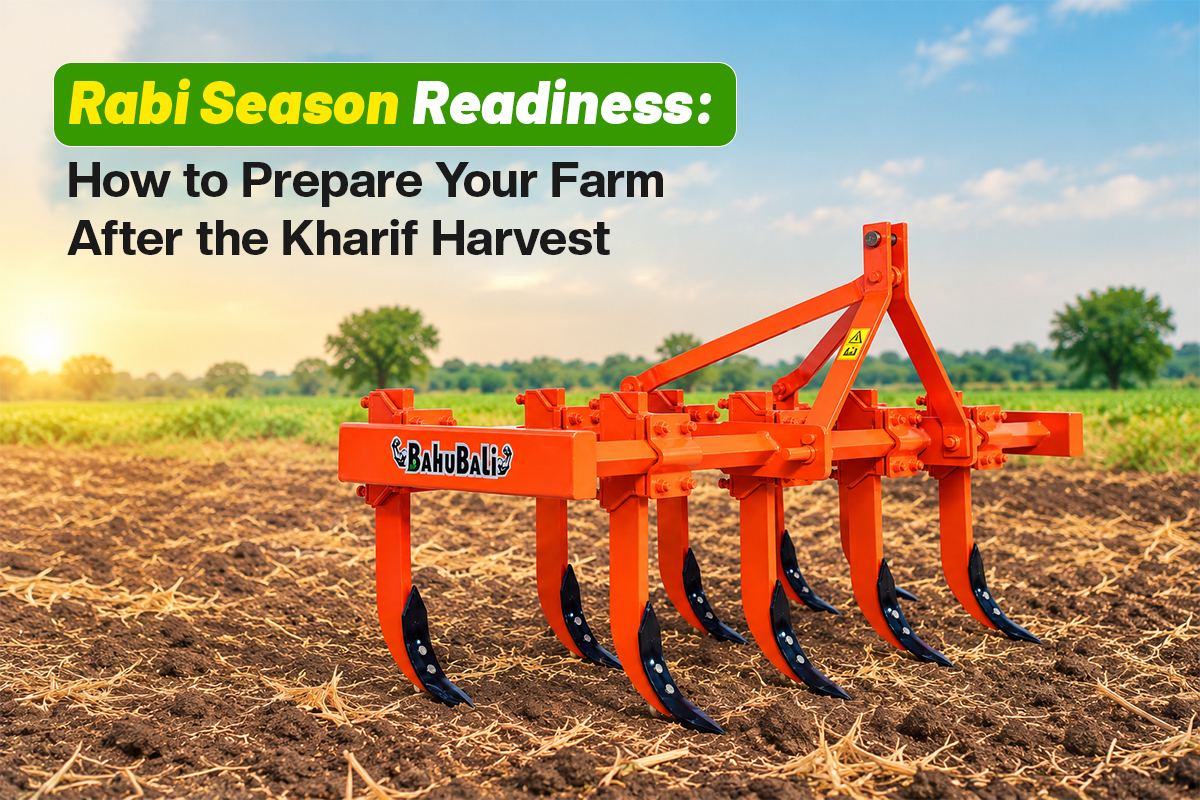
* The Action: A deep pass with a spring-loaded cultivator aerates the soil, allowing it to “breathe” again after months of being saturated with water. This is essential for the healthy root growth of winter crops like Wheat.
Step 3: Moisture Conservation (The “Vapasa” Factor)
Rabi crops rely heavily on the residual moisture left in the soil after the monsoon. If you over-till or leave the soil exposed to the sun for too long, this moisture will evaporate.
* The Tool: Leveler or Rotavator.
* The Action: Immediately after tillage, use a leveler or a rotavator with a trailing plank to “seal” the soil surface. This creates a protective layer that traps moisture in the subsoil, ensuring your seeds have enough water to germinate even if the winter rains are delayed.
Step 4: Precision Sowing
Winter crops, especially small seeds like Mustard, are very sensitive to sowing depth.
* The Tool: Seed-cum-Fertilizer Drill.
* The Action: A precision drill ensures that every seed is placed in the moist zone of the soil and receives its starting dose of DAP or NPK fertilizer exactly where it’s needed.
Benefits for Farmers: Why Readiness Matters
- Higher Yields: Every day you delay sowing wheat after the optimal date (usually mid-November) can result in a yield loss of 1-2% per day. Readiness ensures you hit the “sweet spot.”
- Lower Input Costs: By incorporating Kharif residue, you improve soil fertility, potentially reducing your urea and DAP requirements for the Rabi season.
- Water Efficiency: Good soil preparation and levelling ensure that your first “Kor” irrigation is uniform, preventing water wastage.
- Better Germination: A well-prepared, moist seedbed leads to a 90%+ germination rate, ensuring a dense and healthy plant stand.
How to Choose the Right Equipment/Solution
- For Paddy Farmers: A Super Seeder or a heavy-duty Rotavator is essential to handle the tough paddy straw.
- For Soyabean/Cotton Farmers: A Disc Harrow followed by a Cultivator is often the best combination to manage the woody residue.
- For Small Landholdings: A multi-purpose Cultivator with a leveling attachment is a cost-effective way to prepare the land for various Rabi crops.
Why Bhansali Agrotech?
Bhansali Agrotech (brand: BAHUBALI) is the trusted partner for millions of farmers during the Rabi rush.
* Speed and Reliability: Our implements are designed for high-speed operation without compromising on quality, helping you beat the clock.
* Durability: Rabi soil can be very hard. Our high-carbon steel components are built to handle the stress without bending or breaking.
* Global Reach: We export our Rabi-specific tools to 48+ countries, bringing international best practices to your doorstep.
* 25+ Years of Trust: We have been through 25 Rabi seasons with the Indian farmer; we know exactly what you need.
Frequently Asked Questions (FAQs)
1. When should I start preparing my field for Rabi?
Ideally, preparation should begin immediately after the Kharif harvest. If you are growing Wheat, you should aim to have your land ready by late October or early November.
2. Can I sow Wheat directly after Paddy without ploughing?
Yes, using a “Super Seeder” or “Zero-Till Drill.” These machines are designed to sow directly into the stubble, saving time, fuel, and moisture.
3. How do I prevent the soil from drying out during preparation?
The key is to “till and seal.” Never leave a ploughed field open to the sun for more than a few hours. Always follow your plough or cultivator with a leveller or rotavator to trap the moisture.
4. What is the best implement for Mustard sowing?
A precision seed drill with small-seed fluted rollers is best. Mustard seeds are tiny and must be sown at a shallow, consistent depth (about 2-3 cm).
5. Are Bhansali Agrotech implements eligible for government subsidies?
Yes, most of our implements are approved for various state and central government subsidy schemes, especially those aimed at crop residue management and precision farming.
Conclusion
The Rabi season is the “golden season” for Indian farmers. But to harvest gold, you must first prepare the ground. By using the right combination of rotavators, cultivators, and seed drills, you can turn the post-Kharif challenge into a Rabi opportunity. Bhansali Agrotech is here to ensure you have the best “iron” in the field when it matters most.
Don’t wait for the harvest to end!
Start planning your Rabi readiness today. Contact Bhansali Agrotech to find the perfect implements to help you beat the clock and maximize your winter yields.