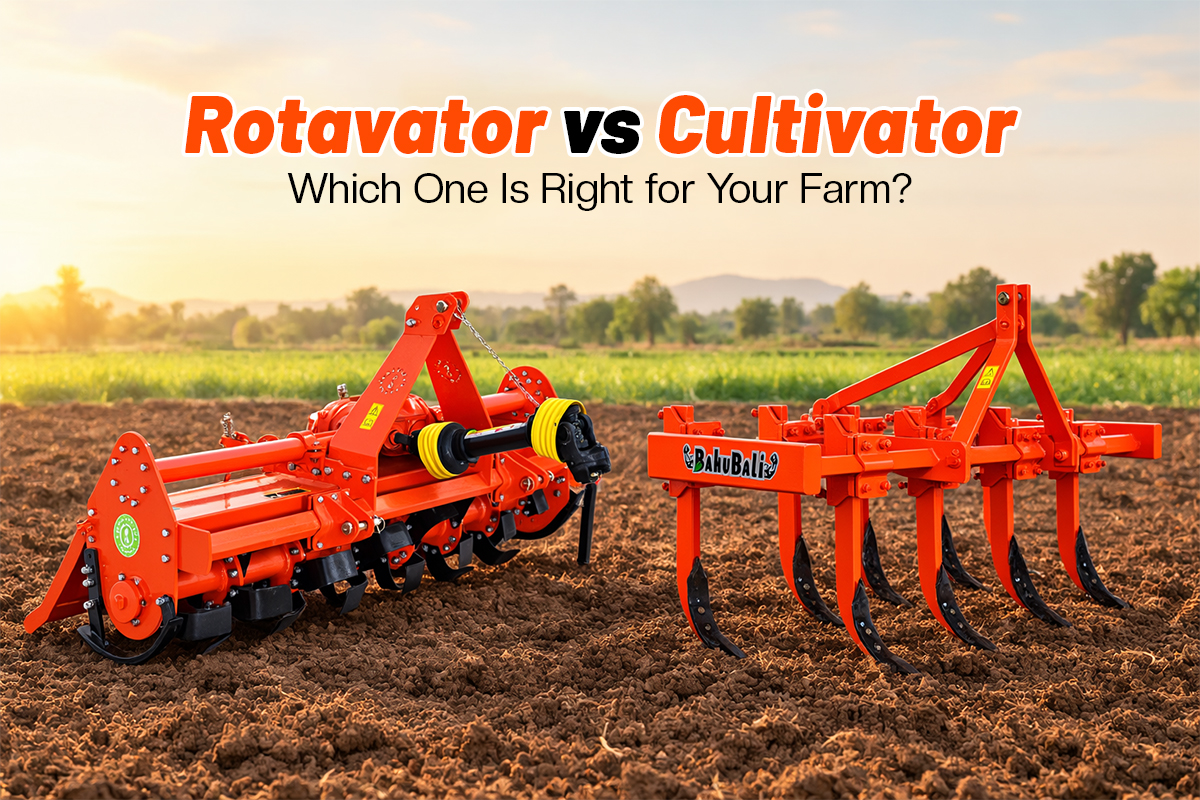
If you walk into any tractor dealership or agricultural fair in India, you will see two implements that look somewhat similar but perform very different roles: the Rotavator (Rotary Tiller) and the Cultivator (Tiller). For many farmers, especially those buying their first tractor, the question is always: “Which one do I really need?”
At Bhansali Agrotech, we have been manufacturing world-class versions of both for over 25 years. We export these tools to 48+ countries, where soil conditions vary from soft sand to hard clay. In this guide, we will break down the “Rotavator vs Cultivator” debate to help you choose the right tool for your specific needs.
Understanding the Basics
What is a Cultivator?
A cultivator is a secondary tillage implement with “tines” (or tynes) that are dragged through the soil. It doesn’t have its own power; it relies on the tractor’s pulling force to break the ground.
* Action: It stirs and loosens the soil, kills weeds, and prepares the seedbed.
* Best For: Secondary tillage, weed control, and working in stony or hard ground where you need flexibility.
What is a Rotavator?
A rotavator is a “power-driven” implement. It connects to the tractor’s PTO (Power Take-Off) shaft, which spins a set of blades at high speed.
* Action: It pulverizes the soil, chops up crop residue, and levels the field in a single pass.
* Best For: Creating a fine seedbed, puddling in paddy fields, and incorporating crop residue (like wheat or paddy stubble) into the soil.
Detailed Explanation: Key Comparison Points
1. Soil Preparation and Tilth
- Rotavator: It produces a very fine, powdery soil structure (tilth). This is perfect for small seeds that need excellent soil contact. It also levels the field as it works.
- Cultivator: It leaves the soil in a more “cloddy” or chunky state. This is often better for water absorption and preventing soil erosion in certain conditions.
2. Time and Efficiency
- Rotavator: It is a “one-pass” machine. It does the work of a plough, a cultivator, and a leveller all at once. This saves a massive amount of time.
- Cultivator: You often need to pass a cultivator through the field 2 or 3 times, followed by a leveller (Patela), to get the same result as one rotavator pass.
3. Tractor Load and Fuel Consumption
- Rotavator: Because it is power-driven, it puts a significant load on the tractor’s engine and PTO. It generally consumes more fuel per hour than a cultivator.
- Cultivator: It is much lighter on the tractor. It is a simple “drag” implement, making it very fuel-efficient.
4. Handling Obstacles (Stones and Roots)
- Rotavator: It is sensitive to large stones. If a spinning blade hits a big rock, it can break the blade or damage the gearbox.
- Cultivator: Most modern cultivators (like the Bhansali Agrotech range) have spring-loaded tynes. If they hit a stone, the tyne simply “jumps” over it and snaps back into place.
Comparison Table: At a Glance
| Feature | Rotavator (Rotary Tiller) | Cultivator (Tiller) |
| :— | :— | :— |
| Working Principle | Power-driven (PTO) | Dragged by tractor |
| Number of Passes | 1 pass is usually enough | 2-3 passes required |
| Seedbed Quality | Fine and level | Cloddy and uneven |
| Residue Management | Excellent (chops and mixes) | Poor (drags residue) |
| Fuel Consumption | Higher | Lower |
| Stone Handling | Sensitive (can damage blades) | Excellent (spring-loaded tynes) |
| Paddy Puddling | The best tool for the job | Not suitable |
Benefits for Farmers: Which One to Buy?
Choose a Rotavator if:
- You have a medium to high-HP tractor (40+ HP).
- You are a paddy farmer (it’s essential for puddling).
- You want to incorporate crop residue (stubble) into the soil instead of burning it.
- You have limited time and want to prepare your field quickly.
Choose a Cultivator if:
- You have a smaller tractor (under 35 HP).
- Your soil is very stony or has many hidden roots.
- You are on a tight budget (cultivators are much cheaper than rotavators).
- You are doing “inter-culture” (removing weeds between rows of standing crops).
Why Bhansali Agrotech?
Whether you need the power of a Rotavator or the simplicity of a Cultivator, Bhansali Agrotech provides the highest quality.
* BAHUBALI Strength: Our frames are reinforced to handle the toughest Indian soil conditions.
* Superior Blades: Our rotavator blades are made from high-carbon/boron steel for longer life.
* Export Quality: We export thousands of these units to 48+ countries, ensuring you get international engineering at an Indian price.
* 25+ Years of Trust: We understand the nuances of Indian farming like no one else.
Frequently Asked Questions (FAQs)
1. Can I use a rotavator for primary tillage?
While a rotavator is powerful, it only goes 6-7 inches deep. For very hard ground, it’s better to use a plough or sub soiler first, then use the rotavator for finishing.
2. Why do people say rotavators “damage” the soil?
If used excessively in the same field every year, a rotavator can create a “hardpan” layer just below its working depth. It’s a good idea to use a cultivator or sub soiler once every 2-3 years to break this up.
3. What size rotavator should I buy for a 45 HP tractor?
A 6-foot (36 or 42 blade) rotavator is usually the perfect match for a 45 HP tractor.
4. Are spring-loaded cultivators better than rigid ones?
In India, yes. Because our fields often have hidden stones or hard patches, the “spring” action protects both the implement and your tractor from sudden shocks.
5. Which one has a better resale value?
Both hold their value well if they are from a brand like Bhansali Agrotech, but rotavators are currently in higher demand in the second-hand market.
Conclusion
The “Rotavator vs Cultivator” choice isn’t about which tool is better—it’s about which tool is right for your farm. If you want speed and a perfect finish, go for the Rotavator. If you have stony soil or a smaller budget, the Cultivator is your reliable workhorse. Many progressive farmers eventually keep both in their shed to handle every situation.
Still undecided?
Contact Bhansali Agrotech today! Our experts will help you analyze your soil, tractor, and crop needs to recommend the perfect implement for your farm.