Every farmer dreams of a “bumper harvest.” We spend thousands on the best hybrid seeds, the most expensive fertilizers, and the latest pesticides. But here is a hard truth: if your soil preparation is poor, you are building a house on a weak foundation. No amount of fertilizer can fix a field that hasn’t been prepared correctly.
At Bhansali Agrotech, we have spent 25+ years studying the relationship between machinery and the earth. We have seen how the right tillage sequence can increase yields by 15-20% without adding a single gram of extra fertilizer. In this practical guide, we’ll show you how to prepare your soil for maximum productivity.
The Goal of Soil Preparation
Efficient soil preparation isn’t just about making the field look “clean.” It has four scientific objectives:
1. Aeration: Getting oxygen into the root zone.
2. Moisture Retention: Ensuring the soil can “breathe” in water and hold it.
3. Weed & Pest Control: Destroying the competition before it starts.
4. Seed-to-Soil Contact: Creating a fine “tilth” so the seed can sprout easily.
Detailed Explanation: The Perfect Tillage Sequence
For most Indian crops, the best results come from a “Primary to Secondary” sequence.
Phase 1: Deep Tillage (Primary)
Once every 2-3 years, you must go deep.
* The Tool: Sub Soiler or Disc Plough.
* Why: Over time, the soil below the surface becomes compacted (the “hardpan”). This layer stops roots from growing deep. A Bhansali Agrotech Sub Soiler shatters this layer, allowing roots to reach deep-seated nutrients and water. This is the “secret” to drought-proofing your farm.
Phase 2: Breaking and Mixing (Secondary)
Once the ground is broken, you need to manage the clods and residue.
* The Tool: Disc Harrow or Heavy-Duty Cultivator.
* Why: These tools break down large chunks of earth and mix in any organic matter (like stubble from the previous crop). This process aerates the soil and starts the decomposition of organic manure.
Phase 3: Finishing and Leveling (Secondary)
The final step before sowing.
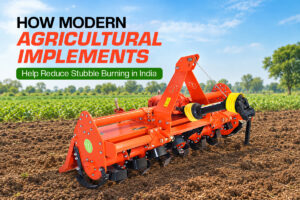
* The Tool: Rotavator.
* Why: The Rotavator is the “finisher.” It pulverizes the soil into a fine, uniform bed. A field prepared with a Bhansali Agrotech Rotavator ensures that when the seed drill passes through, every seed is placed at the exact same depth.
Phase 4: Precision Sowing
- The Tool: Seed-cum-Fertilizer Drill.
- Why: Precision placement of seed and fertilizer ensures that the young plant has everything it needs from Day 1.
Benefits for Farmers: The Payoff
- Uniform Germination: When all your seeds sprout at the same time, your crop matures at the same time, making management and harvest much easier.
- Reduced Input Costs: Well-prepared soil makes fertilizers more effective, meaning you can often achieve better results with less.
- Water Savings: A field that has been sub-soiled and levelled holds water more efficiently, reducing the number of required irrigations.
- Higher Yields: This is the ultimate benefit. Scientific soil preparation ensures the plant is never “stressed” by hard soil or lack of oxygen.
How to Choose the Right Equipment/Solution
- Match the Soil: Use Disc Ploughs for hard, stony ground and MB Ploughs for soft, loamy soil.
- Match the Tractor: Don’t overload your tractor. A 40 HP tractor works best with a 5-foot rotavator. Overloading leads to shallow tillage and high fuel consumption.
- Check the Blades: Dull blades on a rotavator or cultivator don’t cut; they “smear” the soil, which can actually cause compaction. Always use high-quality, sharp blades from Bhansali Agrotech.
Why Bhansali Agrotech?
With 25 years of experience and exports to 48+ countries, we don’t just sell “iron.” We sell “Yield Improvement.”
* Engineering Excellence: Our implements are designed to provide maximum soil shattering with minimum fuel consumption.
* Durability: The BAHUBALI range is built to handle the toughest Indian soils-from the sands of Rajasthan to the clays of Maharashtra.
* Expert Guidance: Our dealer network is trained to help you design the perfect tillage sequence for your specific crop and soil.
Frequently Asked Questions (FAQs)
1. Can I prepare my field using only a Rotavator?
While a rotavator is excellent, using it exclusively year after year can lead to a hardpan layer. It is best to use a sub soiler or plough once every few years for deep aeration.
2. How does leveling help in yield?
A level field ensures that water doesn’t pool in one spot (causing rot) or leave another spot dry (causing stress). Uniform water = Uniform yield.
3. Is deep tillage necessary for every crop?
Deep-rooted crops like Sugarcane, Cotton, and Pigeon Pea benefit immensely. Shallow-rooted crops like leafy vegetables may not need it every season, but the soil still needs periodic deep aeration.
4. How much fuel can I save with efficient soil prep?
By using well-maintained, sharp implements that are correctly matched to your tractor, you can save up to 15-20% on fuel compared to using blunt or mismatched tools.
5. What is the “Vapasa” condition?
This is the ideal soil moisture level for tillage-when the soil is moist enough to crumble but not so wet that it sticks to the machinery.
Conclusion
Success in farming is 80% preparation and 20% management. If you get the soil preparation right, the rest of the season becomes much easier and more profitable. Don’t treat your soil like dirt-treat it like the valuable asset it is.
Ready to boost your yields?
Invest in the right foundation. Contact Bhansali Agrotech today to explore our full range of soil preparation implements. Let’s prepare your farm for its biggest harvest yet!