For centuries, the image of a farmer walking through a field, hand-throwing seeds into the wind, has been the iconic symbol of sowing. This method, known as “broadcasting,” is simple and requires no equipment. However, as we move into an era of high-input costs and the need for maximum efficiency, the old ways are no longer enough. Today, the tractor-mounted Seed Drill is the gold standard for successful farming.
At Bhansali Agrotech, with 25+ years of experience in manufacturing precision sowing equipment, we have seen the data: switching from broadcasting to a seed drill can increase yields by up to 20-25%. In this article, we’ll explain the science behind why precision seeding always wins.
The Problem with Broadcasting
While broadcasting is fast, it is incredibly inefficient. When you throw seeds by hand:
1. Uneven Depth: Some seeds stay on the surface (where birds eat them or they dry out), while others are buried too deep (where they rot before they can sprout).
2. Poor Spacing: Seeds often cluster together, leading to “crowding.” These plants then compete with each other for sunlight, water, and nutrients.
3. Wasted Seed: You often have to use 20-30% more seed to compensate for the ones that won’t germinate.
4. Inefficient Fertilization: Fertilizers are often spread separately, meaning they aren’t always where the young roots need them.
Detailed Explanation: How a Seed Drill Works
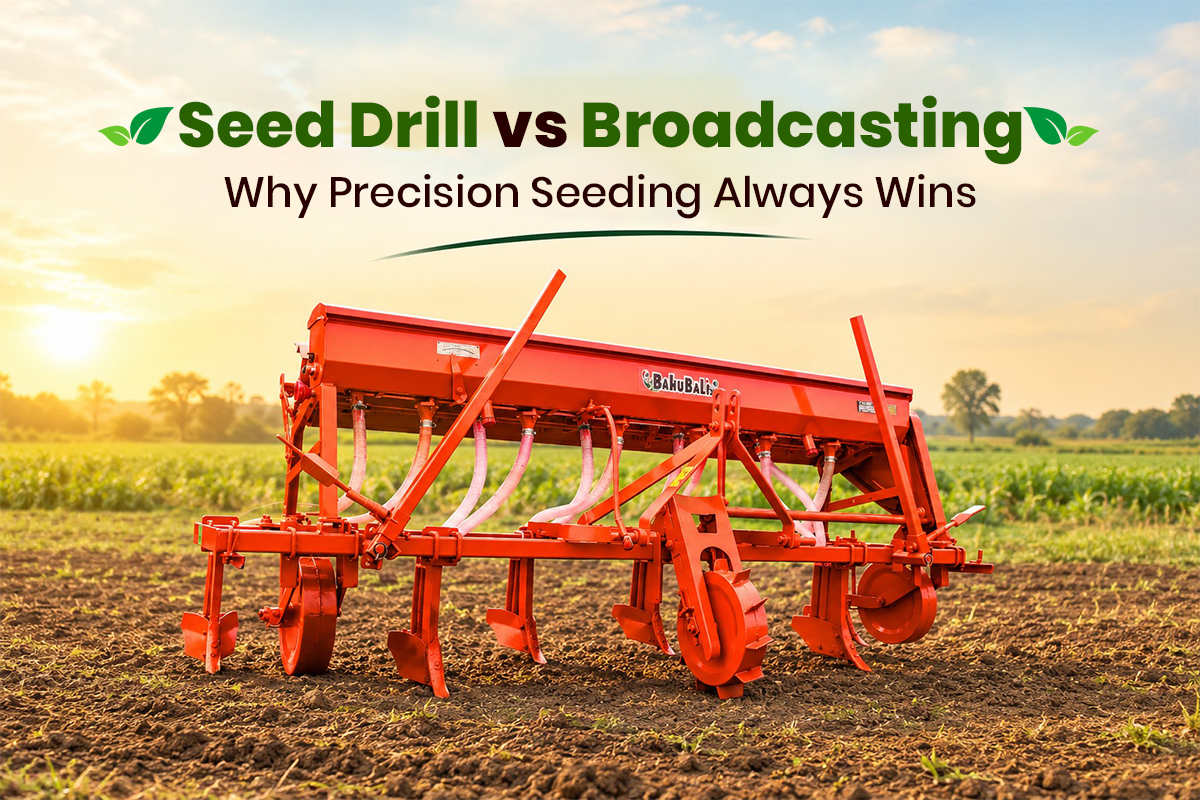
A Seed Drill is a precision machine that performs four tasks in a single pass:
1. Opening the Furrow: It creates a small, uniform trench in the soil.
2. Placing the Seed: It drops the seed at a pre-set, consistent depth.
3. Applying Fertilizer: Most modern drills (Seed-cum-Fertilizer drills) place a dose of fertilizer just below or beside the seed.
4. Covering the Seed: It closes the furrow, protecting the seed from pests and the elements.
The Science of “Plant Stand”
In agronomy, the goal is a “uniform plant stand.” This means every plant in the field is the same height, has the same amount of space, and matures at the same time. This is only possible with a Seed Drill. When plants are uniform, they are easier to manage, easier to spray, and much easier to harvest.
Benefits for Farmers: The ROI of Precision
- Higher Germination Rates: Because every seed is placed at the optimal depth with good soil contact, nearly every seed sprouts.
- Significant Seed Savings: You can reduce your seed requirement by 20-25% compared to broadcasting. For expensive hybrid seeds, this saving alone can pay for the machine in a few seasons.
- Better Nutrient Efficiency: Placing fertilizer exactly where the roots will be (rather than spreading it on the surface) means the crop gets more “bang for the buck” from every bag of fertilizer.
- Reduced Weed Competition: Since the crop is in neat rows, it’s much easier to use inter-culture tools or targeted sprays to remove weeds without damaging the plants.
How to Choose the Right Seed Drill
- Number of Rows: Depending on your tractor HP, you can choose from 9-row, 11-row, or 13-row drills.
- Crop Versatility: Look for a drill that can handle different seed sizes—from small seeds like mustard and bajra to larger ones like wheat, maize, and soyabean.
- Soil Type: For heavy or trashy soils, a “Zero-Till” or “Super Seeder” might be better than a traditional seed drill.
- Calibration: Ensure the machine allows for easy adjustment of the seed and fertilizer rates.
Why Bhansali Agrotech?
Bhansali Agrotech’s seed drills, sold under the BAHUBALI brand, are engineered for accuracy and durability.
* Precision Metering: Our seed-metering systems are designed to prevent seed damage and ensure consistent flow.
* Robust Build: We use high-quality steel for the tynes and furrow openers to ensure they maintain their shape even in hard ground.
* Global Quality: We export our sowing equipment to 48+ countries, meeting international standards for precision and performance.
* 25 Years of Trust: We have spent decades refining our designs based on feedback from Indian farmers.
Frequently Asked Questions (FAQs)
1. Is a seed drill difficult to calibrate?
Not at all. Bhansali Agrotech provides a simple calibration chart and our dealers offer a full demonstration to ensure you are setting the right seed rate for your specific crop.
2. Can I use a seed drill for very small seeds like mustard?
Yes. Our seed drills come with adjustable fluted rollers that can handle everything from tiny mustard seeds to large chickpea seeds.
3. Does a seed drill require a high-HP tractor?
A standard 9-row seed-cum-fertilizer drill can be easily pulled by a 35-40 HP tractor, making it accessible for most Indian farmers.
4. Why is “depth control” so important?
If a seed is too shallow, it lacks moisture. If it’s too deep, it runs out of energy before reaching the surface. A seed drill ensures every seed is in the “Goldilocks zone”—just right.
5. How long does a Bhansali Agrotech seed drill last?
With proper cleaning and seasonal maintenance (greasing and rust prevention), our seed drills are built to serve your farm for 10-15 years.
Conclusion
In the battle of Seed Drill vs Broadcasting, there is no contest. Broadcasting is a gamble; a Seed Drill is a strategy. If you want to stop wasting seeds and start maximizing your yields, it’s time to move to precision sowing. Bhansali Agrotech is here to provide the tools you need for a more professional, profitable farm.
Ready to see the difference in your fields?
Contact Bhansali Agrotech today to find the perfect seed drill for your tractor and crop type. Let’s make every seed count!